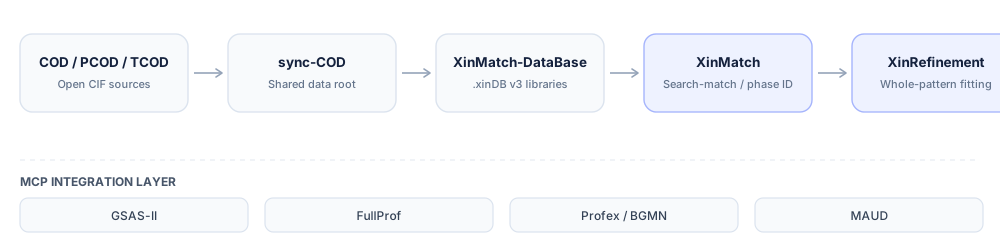
XinMatch
Open-source powder XRD phase-analysis platform: search-match, sequential multi-phase identification and Rietveld quantification, with a PySide6 GUI, CLI and Python library API.
Python
View repository
XinProf builds open tools for phase identification, whole-pattern fitting, reference databases and AI-agent integrations — grounded in published algorithms and open crystallographic data.
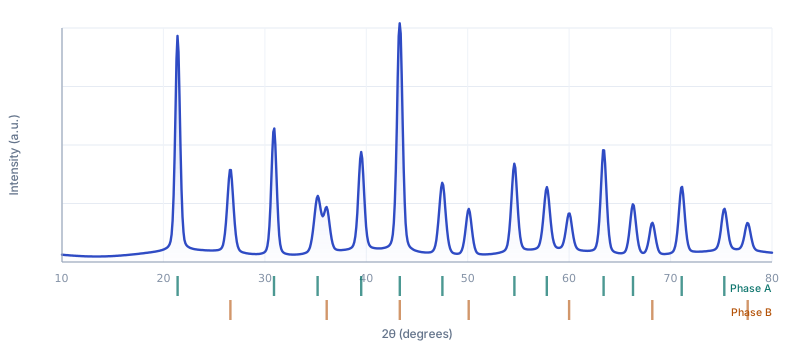
Ten public repositories covering the full path from raw diffraction data to a refined crystal structure — plus the reference libraries and agent integrations that connect it all.
Open-source powder XRD phase-analysis platform: search-match, sequential multi-phase identification and Rietveld quantification, with a PySide6 GUI, CLI and Python library API.
Desktop application for whole-pattern fitting — Rietveld structural refinement, Le Bail and profile refinement, with a Qt6 GUI, CLI and Python library API.
Build scripts, format specification and release artifacts for .xinDB v3 reference phase libraries — COD / PCOD / TCOD and Materials Project.
Shared COD / PCOD / TCOD source-data root for the two database builds, with acceptance and sync tooling. The CIF data itself is not included.
Converts between powder diffraction spectrum formats: xy, txt, dat, csv, mdi, raw, xrdml and json.
Synthetic XRD pattern generator that simulates diffraction patterns to support phase identification and algorithm validation.
MCP server for GSAS-II — Rietveld refinement, crystallographic analysis and protocol integration.
MCP server for FullProf — Rietveld refinement and powder diffraction analysis.
MCP server for Profex/BGMN — XRD analysis, search-match, COD database and Rietveld refinement.
MCP server for MAUD — combined diffraction analysis, texture, stress and structure analysis.
Open CIF sources are indexed into reproducible reference libraries, consumed by the applications, and connected to established refinement engines through the MCP layer.
XinProf develops powder X-ray diffraction software using a clean-room approach: behaviour is derived from official documentation, published algorithms and black-box file-format observation for interoperability.
Reference libraries are built from the Crystallography Open Database (CC0) and other open sources. Proprietary reference databases are never redistributed. All ten repositories are public and distributed under a dual Academic + Commercial license.
For commercial licensing or collaboration, get in touch by email.